The three scripts
Japanese is written with three scripts that work together. You don’t have to master all of them on day one. Most beginners start with hiragana, then katakana, and meet kanji a little at a time.
ひらがな · Hiragana
Hiragana is the rounded phonetic script. Every sound in Japanese can be written with it, and you’ll see it in almost every sentence.
ねこ
neko
cat
A greeting you’ll meet early: こんにちは konnichiwa — hello.
カタカナ · Katakana
Katakana is a more angular phonetic script. It’s often used for loanwords, names from other languages, and a little emphasis.
アイス
aisu
ice cream
Another everyday one: コーヒー kōhii — coffee.
漢字 · Kanji
Kanji are characters that carry meaning. One character can have more than one reading, and you’ll learn them in small, useful groups.
日本
Nihon
Japan — the 日 here is read nichi / ni. By itself, 日 can also mean sun or day.
Two more simple ones: 女 onna — woman, and 円 en — yen.
How they work together in a sentence
A typical sentence mixes the scripts. Hiragana often holds the grammar, katakana may hold a loanword, and kanji can stand in for content words once you know them.
わたしはアメリカじんです。
watashi wa amerikajin desu
I’m American.
Broken into pieces:
- わたし watashi — I (this can also be written with the kanji 私)
- は — a particle that marks the topic. It’s written ha and said wa
- アメリカ — America, written in katakana as a loanword
- じん jin — person (often written with the kanji 人)
- です desu — a polite ending that closes the sentence
So the same idea can also appear as 私はアメリカ人です。 Same sentence, a few kanji folded in. You don’t have to read that version first.
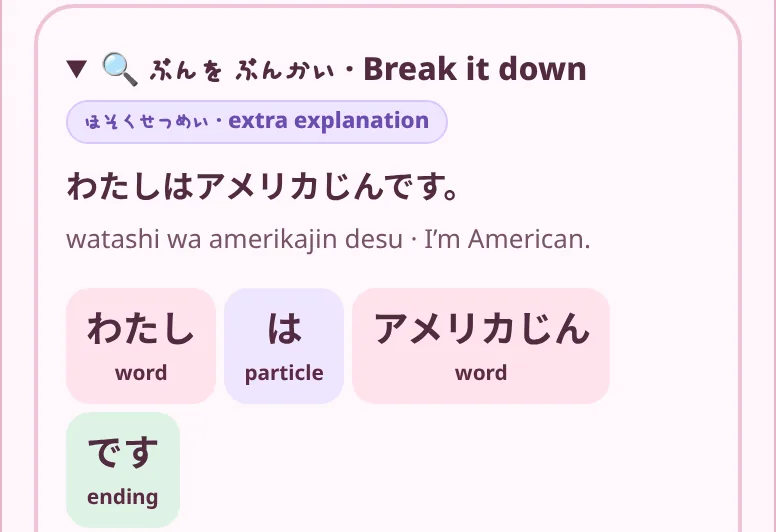
In Catnap, you can break a sentence into pieces so each part has a chance to make sense.
A little grammar, gently
Japanese grammar is different from English, and that’s okay. A few ideas will carry you a long way:
- The verb or a polite ending like です often comes at the end of the sentence.
- Little words called particles mark the role of what comes before them. は marks the topic, が often marks the subject, and を marks the object of a verb.
- You can be understood with short, polite sentences long before you know every pattern.
You don’t have to finish a textbook before you begin. Catnap’s grammar section walks through one idea at a time, with examples you can hear in a natural Japanese voice. When a sentence feels like a puzzle, the breakdown view is there to help.
How Catnap keeps the pace kind
Starting a new writing system can feel big. The app is built so a little each day can add up — without asking you to cram.
- A small daily new-card limit. Only a few new cards a day, so tomorrow doesn’t turn into a pile.
- Due-today review. Come back to what is actually due, not an endless stack. A short review protects what you already learned.
- Short sessions. You can do a little and stop. Consistency matters more than a long sitting.
There’s a gentle path through JLPT N5 and beyond, with kana, kanji, grammar, stories, and games waiting when you’re ready. Study on your Android device, even offline. Mochi and Hannah will be here for the small days and the bright ones.
Whenever you want to peek at the whole app, take the tour — or simply start with hiragana and go at your own pace.